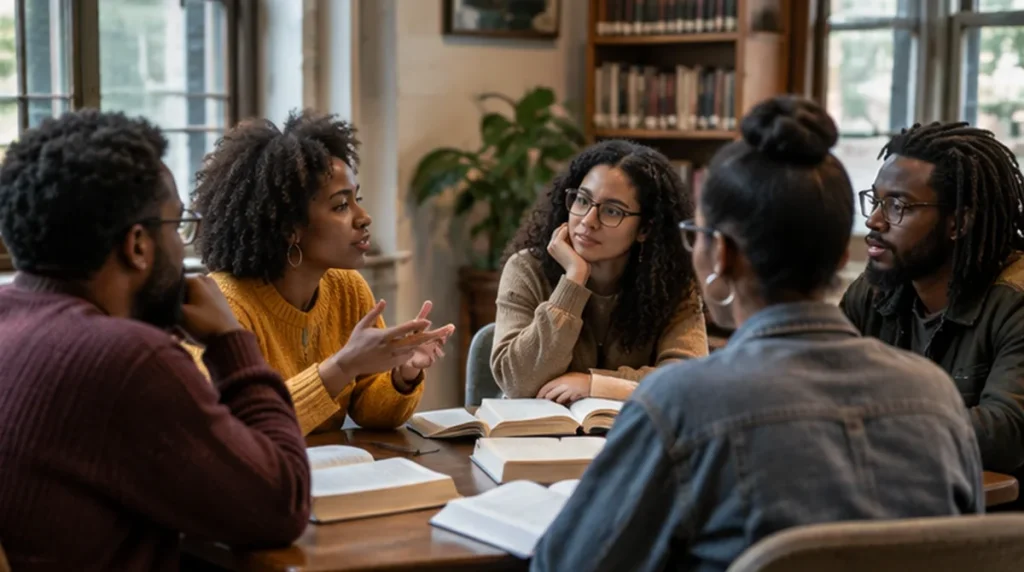
This is an independent archival guide to a work originally published on the former bell hooks Institute website. It is not the original essay. The publication date below refers to the original site; the reconstruction was prepared in 2026.
Friendship as political practice
The original post was dated December 14, 2015, although its legacy URL contains December 12. It reflected on feminist friendship and conversations across generations, including ties with Gloria Steinem and dialogue with Emma Watson. Its focus was not the erasure of disagreement but the possibilities that continued engagement can make visible.
A movement rather than a label
The essay distinguished commitment to feminist political change from treating feminism exclusively as a personal identity or lifestyle. That distinction shaped its view of teaching: asking what people mean by feminism can open the door to examining the systems and everyday practices that sustain sexism and hierarchy.
Community and intellectual generosity
By describing friendships across difference, the essay located theory in actual conversations. Relationships were neither frictionless nor merely symbolic; they required listening, questioning and shared attention to liberation. The post also offers a useful early snapshot of the Institute’s public-facing interests.
What a provocative title can open up
“Feminism Is Fun!” may sound like a playful slogan, but the historical essay points to a serious question: how can a movement dedicated to changing oppressive conditions also foster joy, generosity, and meaningful relationships? Public discussions of feminism frequently center conflict, necessary critique, and unequal access to power. Those questions remain essential. Yet a movement also contains the everyday activities that make sustained participation possible—reading together, challenging assumptions, forming friendships, and discovering that disagreement need not end a conversation.
The title therefore works as an invitation rather than a denial of difficulty. It suggests that feminist learning is not restricted to formal lectures or moments of confrontation. Ideas travel through a conversation after an event, a recommendation of a book, or a friendship that deepens over time. In such settings, a person can encounter questions they had not previously imagined asking. The archive preserves the outline of this invitation without reproducing the historical author’s copyrighted prose.
Across generations and experiences
The original post referred to relationships with well-known women including Gloria Steinem and Emma Watson. These references are historically specific, but the larger theme reaches beyond any celebrity relationship. Conversations across generations can open different kinds of knowledge: memories of earlier campaigns, insights from contemporary media, and arguments about where feminist politics should move next. None of these perspectives is automatically sufficient by itself.
A conversation may reveal that people use the same political word in different ways. One person may emphasize equal legal rights, another economic opportunity, another freedom from intimate violence, and another transformation of the institutions that reproduce hierarchy. Asking what someone actually means creates space for both common ground and sharper distinctions. It is different from assuming that agreement on a label guarantees agreement on action.
Why friendship is more than agreement
Friendship can be intellectually demanding. It may bring people into contact with perspectives they would otherwise avoid and can expose the limits of a comfortable worldview. The historical essay associated feminist engagement with exchanges in which differences are voiced rather than hidden. That is a valuable corrective to the idea that a political friendship has value only when it confirms beliefs that are already settled.
Yet friendship should not be used as a substitute for accountability. Disagreements about domination can involve uneven risks, unequal resources, or people whose concerns have historically been dismissed. Keeping a conversation open means being willing to ask who is carrying the burden of compromise. A generous discussion may be warm, but it should also be honest about material circumstances. The most productive friendships combine care with a willingness to examine power.
Learning feminism outside a classroom
Many readers first encounter feminist ideas through books, films, conversations with relatives, workplace experiences, or community organizing rather than through university courses. The concept of learning across contexts is important to bell hooks’ wider public identity as an educator. Her writing encouraged readers to connect critical thought to the way they live with other people. That connection makes the essay relevant to educational archives as well as to histories of political movements.
For a discussion group, the text can serve as an occasion to ask concrete questions. What kinds of disagreement have helped people learn? When has a friendship made social expectations visible? How can a group invite people who are curious but uncertain without abandoning its principles? These questions do not have to produce identical answers. The educational value lies in examining how conversations help people name their experience and revise their habits.
Joy as a condition of endurance
Movements often require sustained work over years. Attention to injustice can create urgency, but urgency alone is difficult to maintain. Shared meals, humor, art, companionship, and moments of discovery can help communities endure. To notice pleasure within political struggle is not to treat injustice lightly. It is to recognize that people need reasons to stay involved and forms of care that prevent isolation from becoming the dominant experience of collective work.
Seen from this angle, “fun” is a question about political culture. Is participation associated only with demonstrating that one is correct, or is there also room for creativity, curiosity, and the possibility of being changed by others? The original essay’s historical importance includes its insistence that feminist thought belongs in ordinary relationships, not merely in academic terminology.
Bibliographic details and source boundaries
The legacy URL contains the date December 12, 2015, while the archived post displays a publication date of December 14, 2015. Both details should be retained when documenting the source, rather than silently forcing them to agree. A path may reflect when a draft or publishing system first assigned a slug; that is a possibility, not a verified explanation of this particular discrepancy.
Readers who need bell hooks’ precise wording should follow the original capture linked below. This modern commentary is a study guide. The Berea College overview of bell hooks provides institutional biographical context, while the archive’s independent essay on teaching explores how critical dialogue operates in educational settings.
Why this small publication belongs in the archive
Not every historical document is important because it introduced a new theory. Some matter because they show how an intellectual project was communicated to a wider audience. This post offers a glimpse of an Institute website where books, interpersonal exchanges, and public feminist discussion appeared together. Preserving the page helps readers reconstruct that editorial setting, even when they encounter the source many years after its publication.
Original source and related reading
Read the preserved Internet Archive capture. See also Sources & Provenance and other historical and editorial records.